


A HIDDEN LIFE OF CHRIST
By
A Nun in Formation at the Cistercian Monastery of Valley of Our Lady
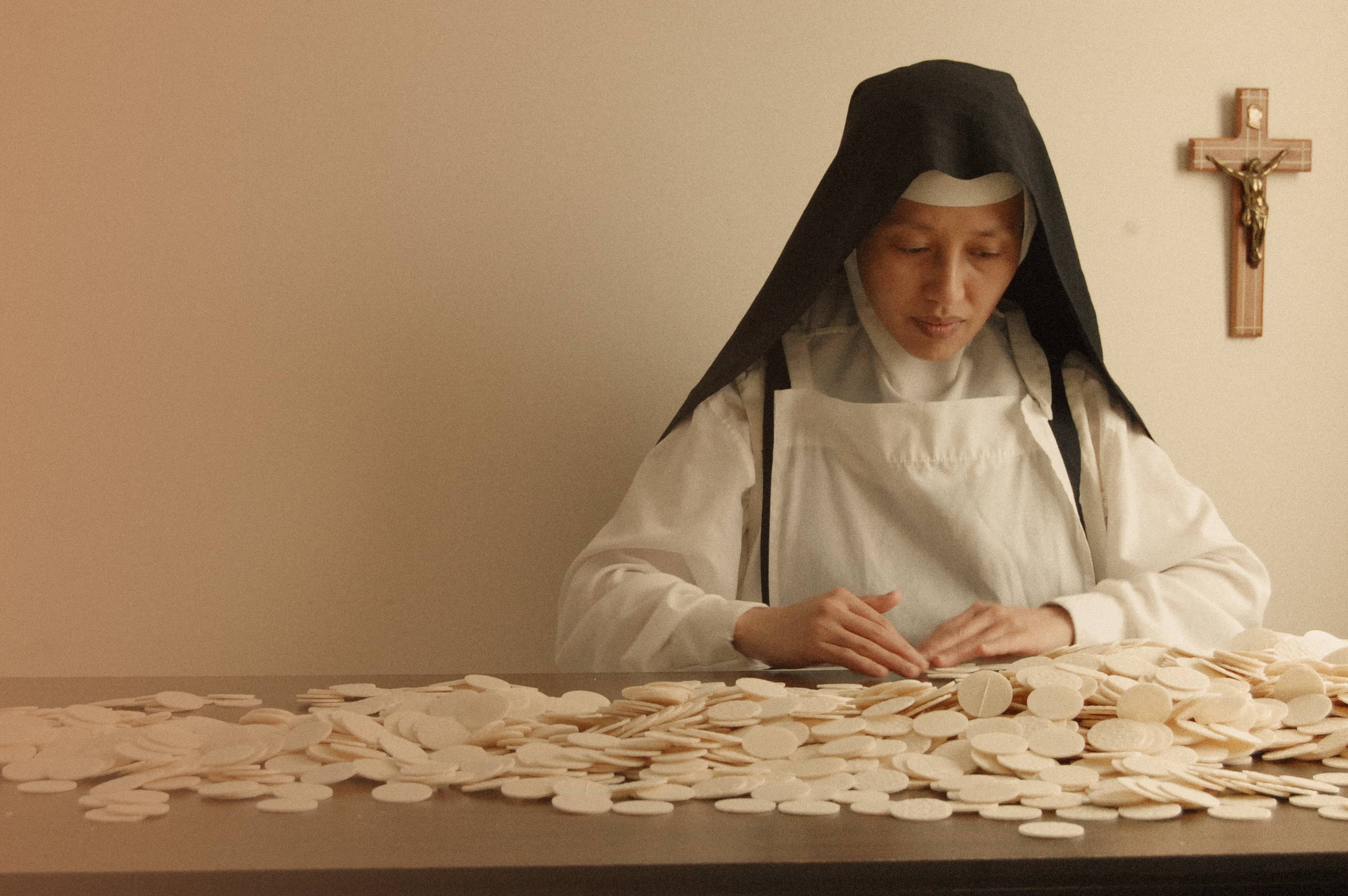
Cistercian monastic contemplative life is hidden with Christ in God,1 a life finding its source and summit in the liturgy2 with all things ordered to union with Jesus Christ, the Divine Bridegroom in praise of the Blessed Trinity. Inheriting the balance of ora et labora from our Holy Father St. Benedict and following our Cistercian Fathers in manual labor, we find expression of our union with the Eucharistic Christ in uniting our offering to His by making our own the work of human hands3 that is the bread, the matter for the Eucharistic species. The mystery of His Presence in the Eucharist is a paradox of proximity and hiddenness. He who delights to dwell among the children of men4 makes Himself abased in divine humility to come in the form of simple bread. This divine catechesis is formative for the nuns as we give of our own labor to contribute to making Him present to the world through our hidden life as we become a grain of wheat daily dying to ourselves5 until it is no longer we who live, but Christ who lives in us.6 Each stage of the process becomes a possibility for union; each work opens to its own prayer, particular to the heart of each nun wrapped in the silence of a heart immersed in the Word. Each has her own way of adoration, intercession, thanksgiving, and vulnerable receptivity to the Word in the daily life. The following reflection is drawn from one nun’s experience of the symbols present in the baking process.7
Weighing and Mixing
All the ways of a man are pure in his own eyes, but the Lord weighs the spirit. Proverbs 16:2

Cistercians have always lived in places of solitude, close to the earth and agricultural pursuits. Our flour comes to us from outside sources, yet adjacent fields remind us of the many images in scripture drawn from the grain of wheat which exemplify asceticism and purification of the heart. The separation of weeds and wheat,8 kernel and chaff9 found within the human heart comes to bear in the silence of the enclosed life, which is necessary for the sanctification of each nun. This spiritual battle has its effects building up the whole Church. Pope Francis speaks this to reality, “Your contemplation can become a spiritual combat to be fought courageously in the name of, and for the good of, the entire Church, which looks to you as faithful sentinels strong and unyielding in battle.”10 Heavier manual labor is conducive to working out the healing of memory necessary for interior silence. This first step of the altar bread process–weighing out hundreds of pounds of flour in preparation for baking–is an opportunity to dig deeply into the heart and lay bare areas in need of healing and conversion. Intercession comes to surface too as the flour sifts into containers. Recognition of our own weakness moves us to pray for others such as the hierarchy, aware that all those in the Lord’s service experience the sifting of Satan.11
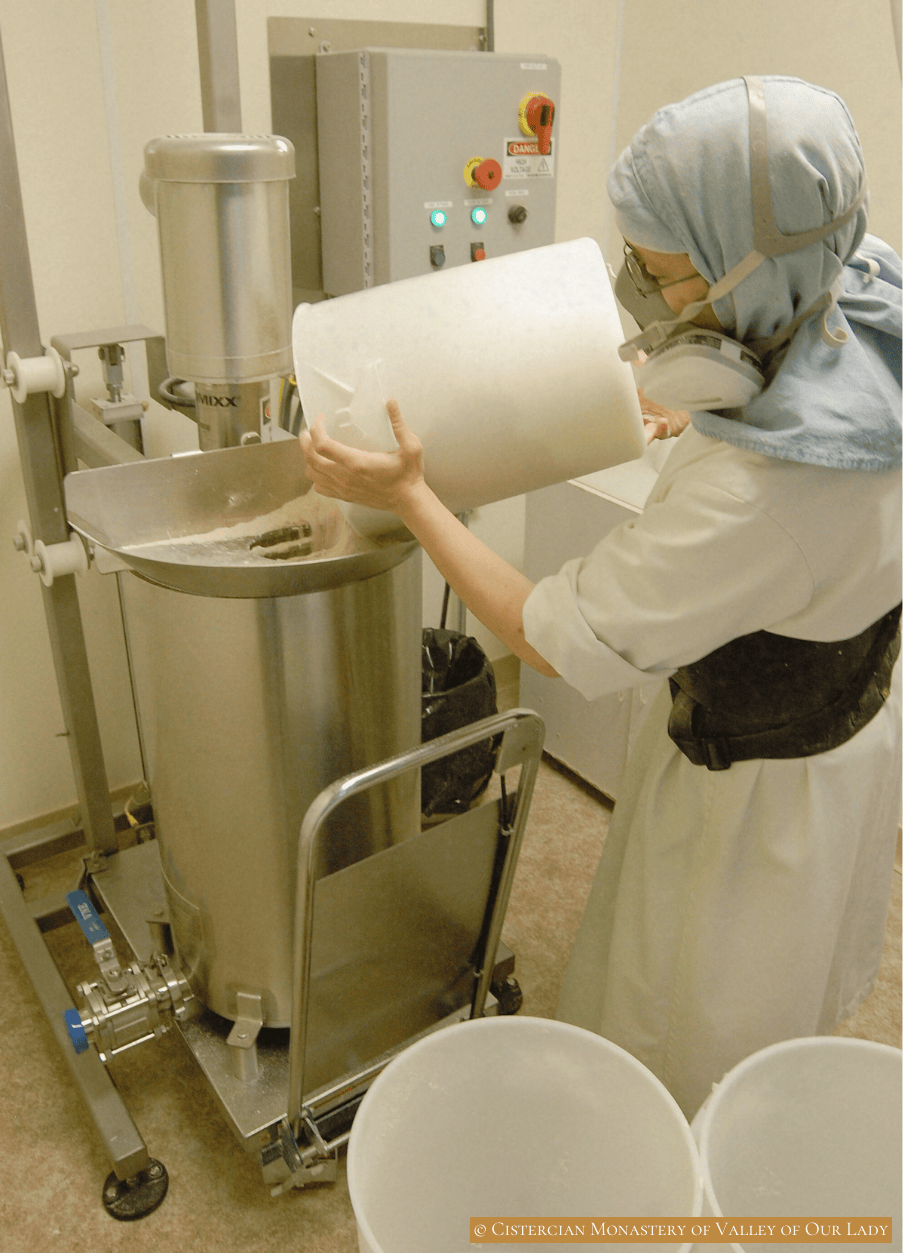
The next step–mixing the water, wheat germ oil, and flour–requires a vigilance to ensure even mixing and correct viscosity that the batter, which is not unlike a runny pancake batter, may bake evenly without spot or wrinkle. The roar and gurgle of nearly twenty gallons mixing allow us to experience solidarity with the noise of world and while these moments generally pass quickly, they contain formative lessons for the nun as well. The violence with which these three simple ingredients are blended in the mixer is not unlike the intensity sometimes experienced in the spiritual life.12 The end result of a few minutes mixing is a smooth libation of fine flour poured out ready for baking.
Baking
Love’s flashes are flashes of fire, a most vehement flame. See Song of Songs 8:6
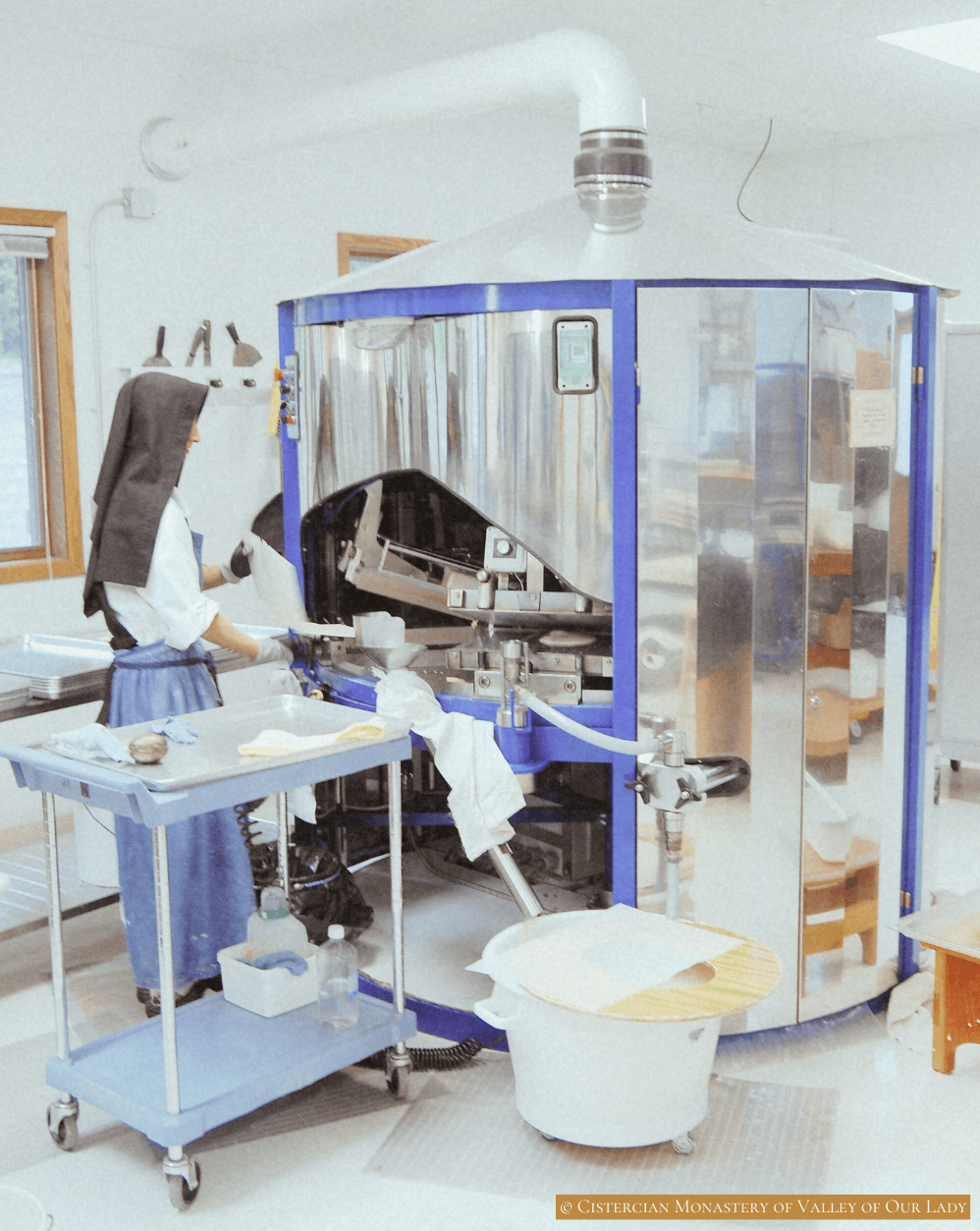
The wafer bakers are equipped with iron griddles similar to a waffle iron which imprint crosses or other designs reflecting what the bread will become. These rotate on a carousel before the nun baking who removes the rectangular sheets of wafer and prepares the plate for its next measure of batter which includes scraping any crumbs or residue and flooding it with water spray to produce an even bake. The warmth of the oven is a comforting heat in the Wisconsin winter and an added asceticism in the summer months. Each baked sheet of bread is checked for its worthiness to be used during the Holy Sacrifice.
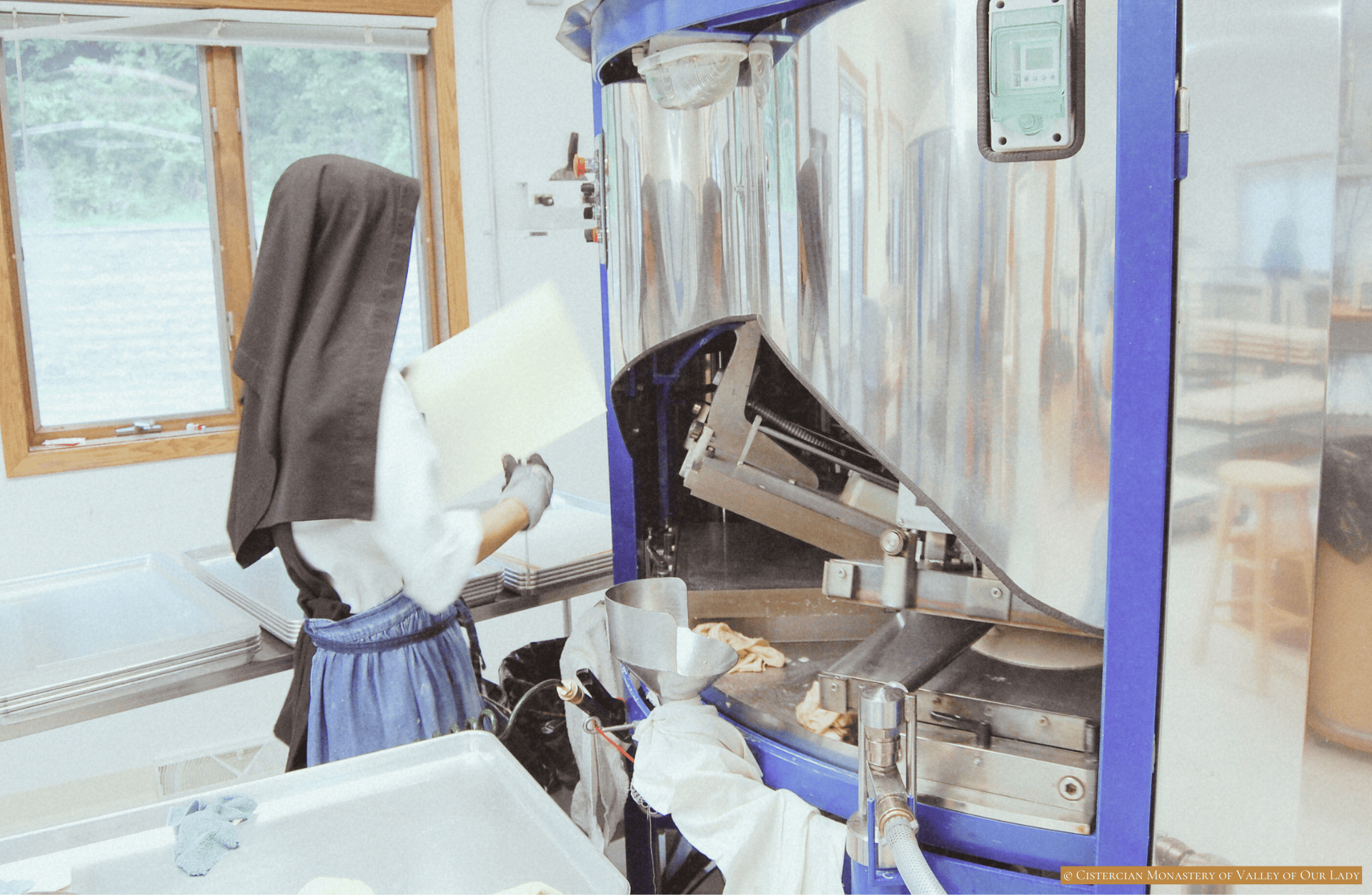
The baking experience brings a solitude as only one nun operates it at a given time. Here the batter is transformed to bread by a heat emanating and palpable. The rhythm of the work produces an interior silence with an openness to the Word allowing the Holy Spirit to bring His fire of transforming love. Cistercian life is ordered to restoration of the divine likeness which the Holy Spirit works in the depths of each soul. This likeness comes through fires of purification as well as the fire of desire stirred up in flame.13 It is a process that lasts a lifetime until the day that the nun stands before her Bridegroom and finds that she is like Him for she sees Him face to face.14
Resting
Rest in the Lord and wait patiently for Him. Ps 37:7
Beginning with the seventh day of creation until the Parousia, the Lord calls us continually to find our rest in Him. Even the land itself must have its rest and when Israel does not heed this law of rest, exile is the punishment. The bread too has its rest. It is stored away awaiting the next stage, hidden very much like ourselves. It is an important part of the process and continues through our own resting and rising, giving praise again for the mercies of the Lord which are new every morning.15 As the bread rests, the nuns continue with the other stages, but the call to rest remains even in activity. It is in the Word that the heart rests while the hands busy themselves about many things.16 Each nun then becomes a Bethany and takes the role of Martha, Mary, and Lazarus welcoming Jesus with work, repose, and response to His restoring call.17
Humidifying
Open to me, my sister, my love, my dove, my perfect one; for my head is wet with dew. Song of Songs 5:2

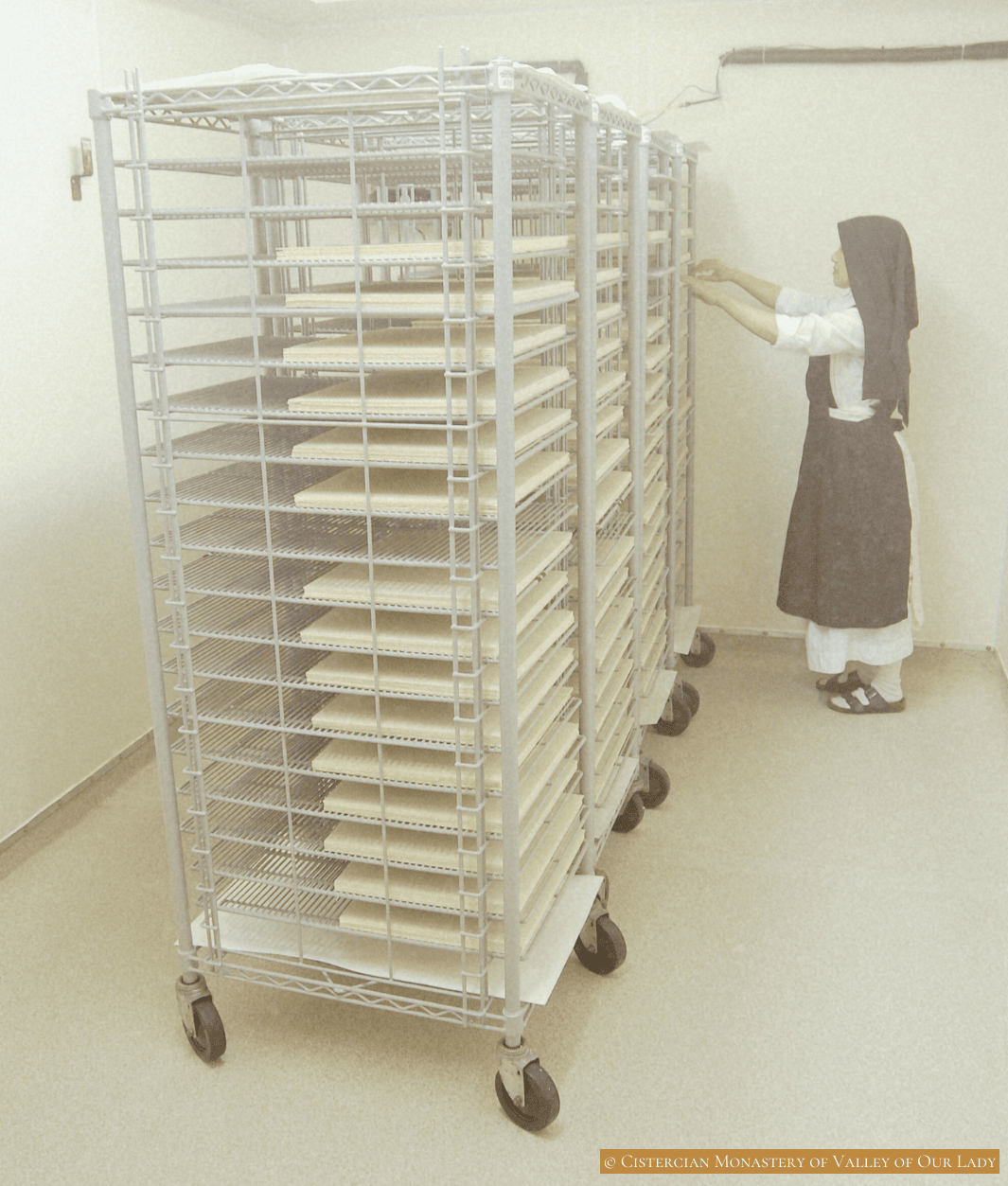
After resting, the bread must be softened by humidifying to allow it to cut without breaking. When one walks into the room where this takes place it is like walking into a warm cloud. A nun monitors the process to ensure the even quality. The Holy Spirit works in a similar way, first softening the heart to be docile and open to the voice of the Bridegroom. This hidden work in the heart prepares for those renunciations which cut off18 all that is superfluous to following the Lamb.19 Like the Transfiguration experience, the cloud overshows and the voice is heard, “This is my beloved Son; listen to Him.”20
Cutting and Sorting
Because there is one bread, we who are many are one body, for we all partake of the one bread. 1 Corinthians 10:17
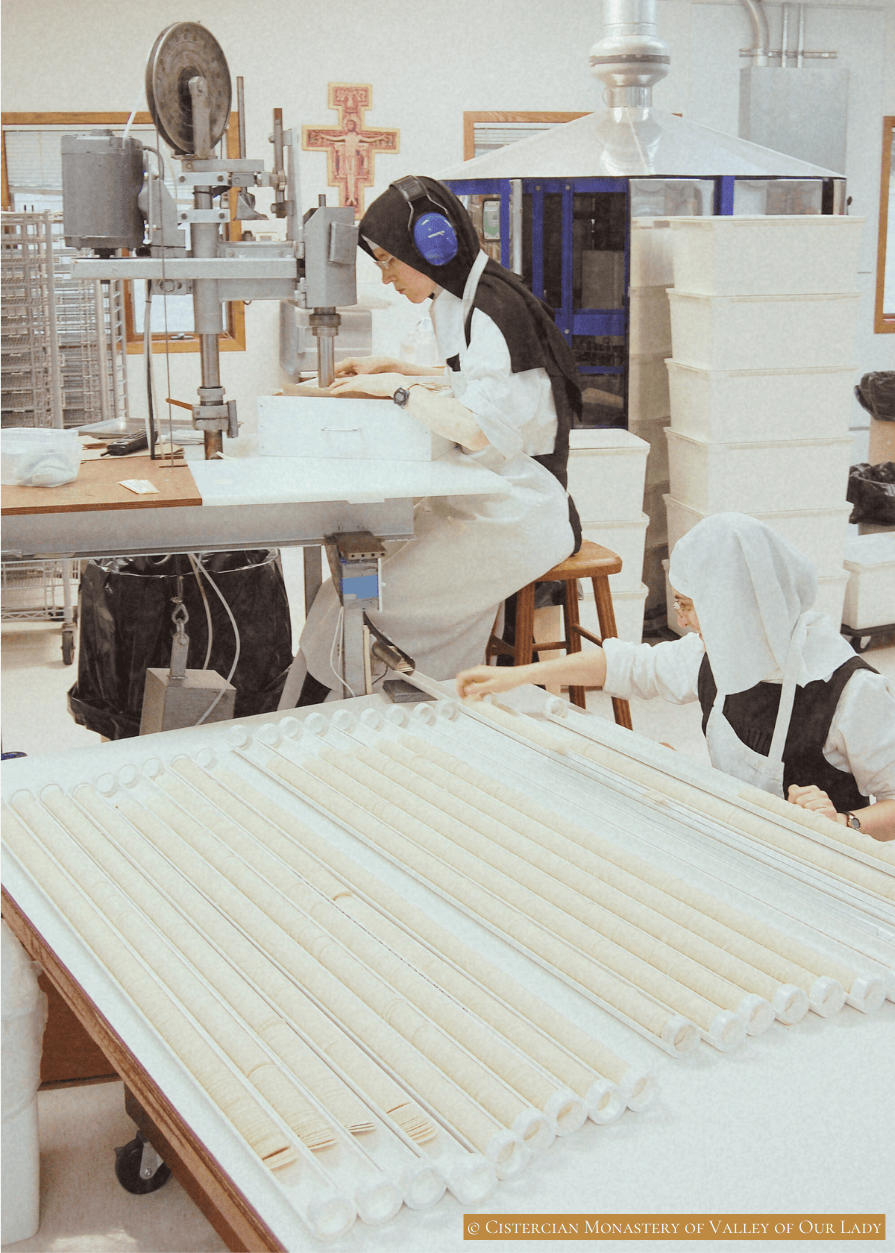
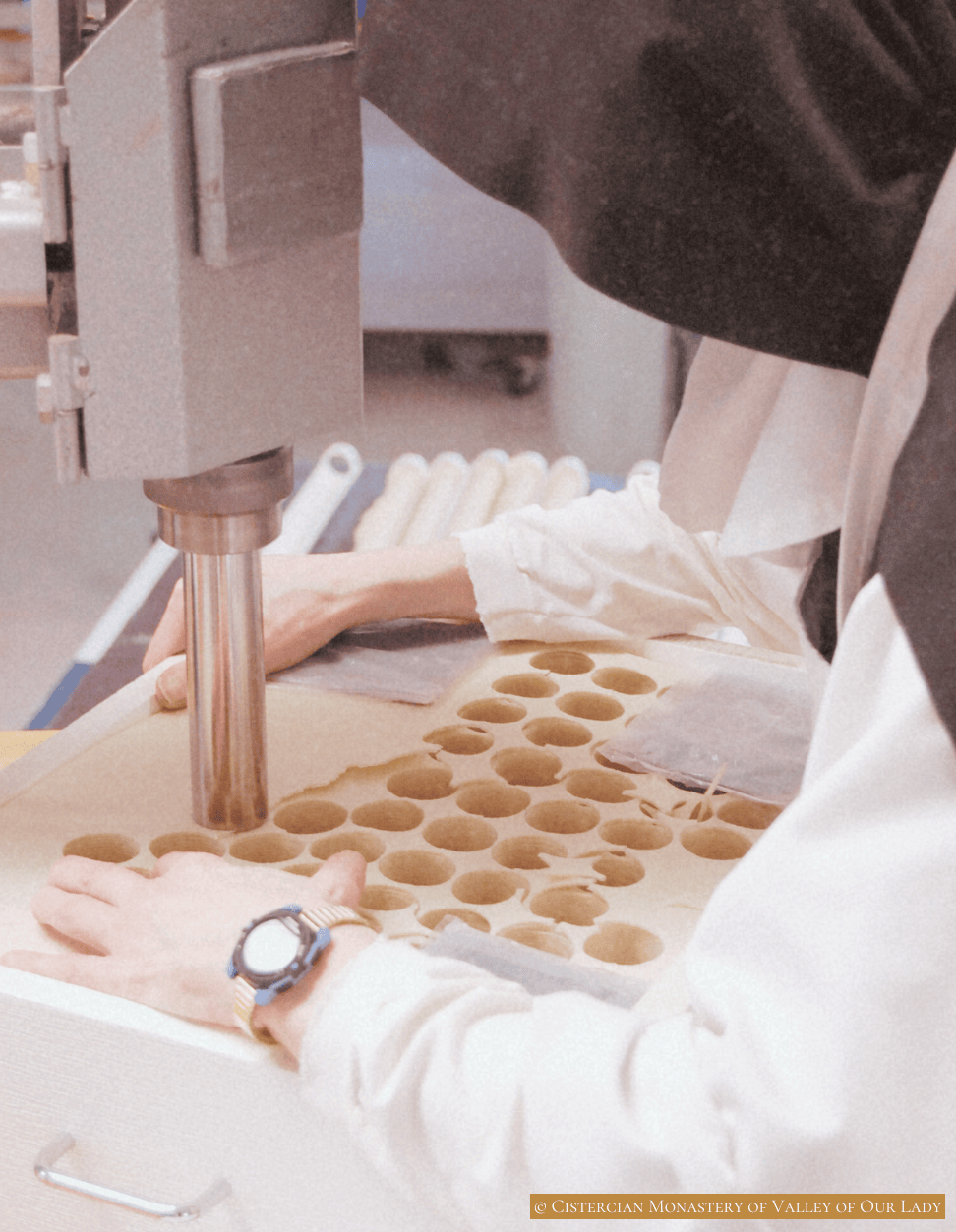
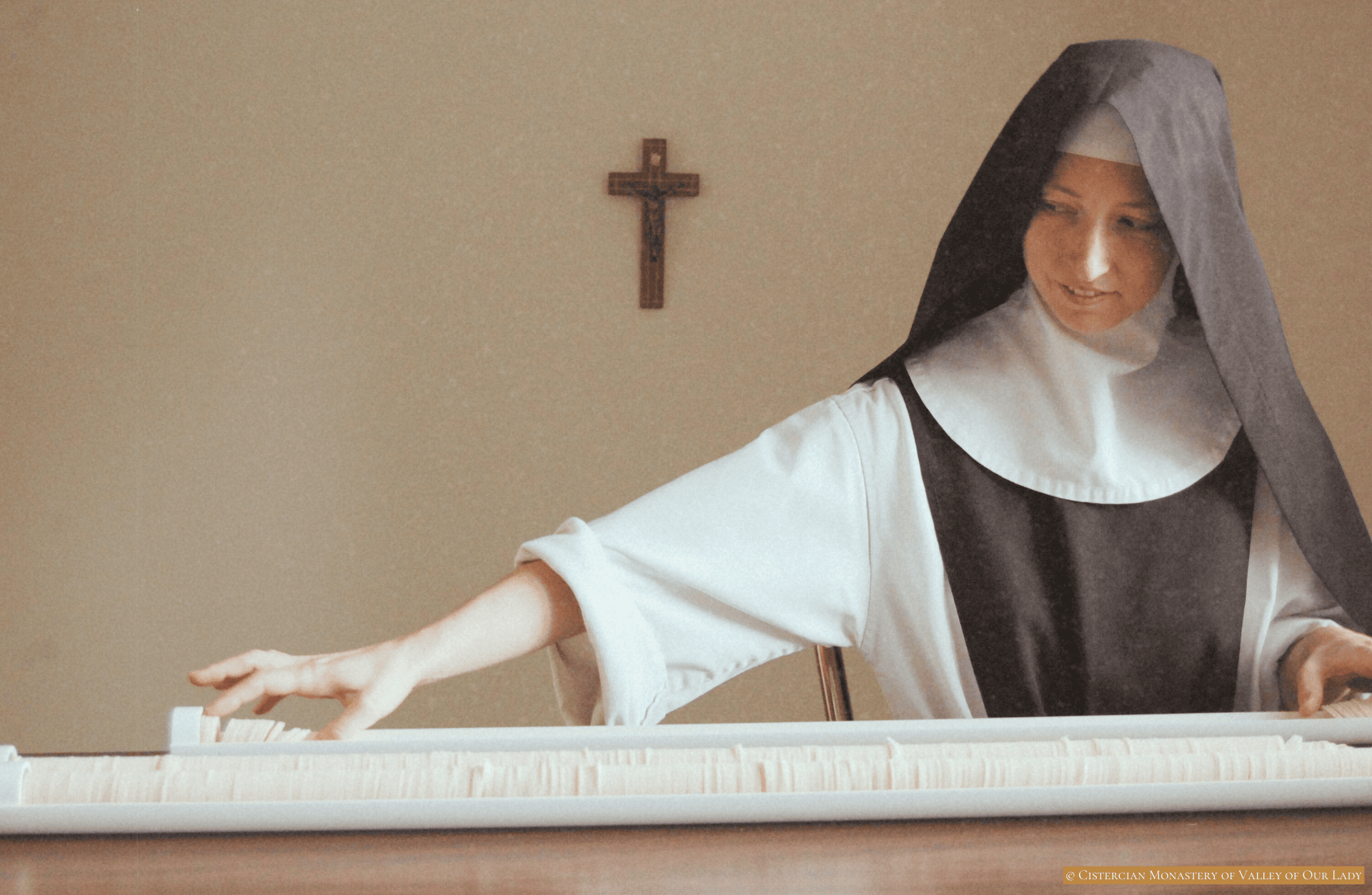
This stage of the process is quite communal. We continue to keep silence, each engaged with her own prayer in the secret recesses21 of her own heart, yet side by side we are attentive to the work of the other. While one sister cuts stacks of fifty sheets into the familiar round discs, the others sort out any bread with imperfections. Each side is checked for flaws. A steady rhythm can keep pace with decades of the rosary. The mind goes to intercession for the First Communicants or those who will receive Viaticum. Working with the celebrant’s bread tends toward intercession for priests. This work has a steady, simple quality that frees the mind almost completely for a deep prayer of the heart. Contemplation of scripture verses, adoring Our Lord present in all the tabernacles of the world, such thoughts can lead to an intimate union. It is work not unlike the basket-weaving tasks of the desert monks of old. This prayer, whether of direct intercession or focused on the Lord alone in adoration, contributes to the building up of the whole Body of Christ, which is the Church, as our lives become increasingly united to the Eucharistic Heart of Jesus.
Packing and Shipping
No speech, no word, no voice is heard yet their span extends through all the earth, their words to the utmost bounds of the world. Psalm 19:3-4
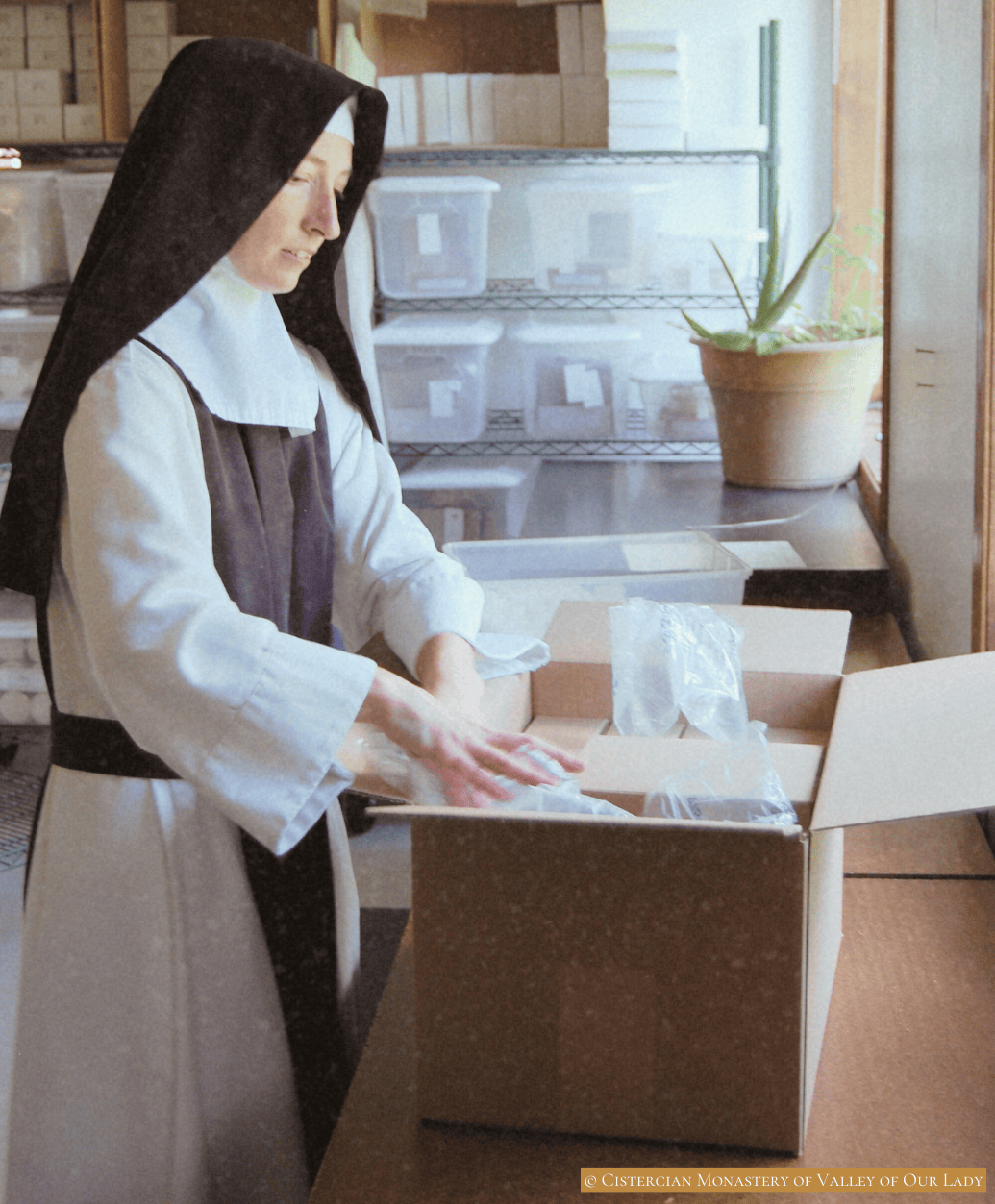
Though we live a life of hiddenness and silence our packing and shipping office is a small reflection of the reach of our life. Most often, our life and its influence on the Church is hidden from ourselves. We live in the faith that our own prayer and self-offering united to that of Jesus’ is bearing fruit in ways that we will only know in eternity. It is enough to be given to Him, to offer our own fiat in Our Lady’s. The altar bread we bake is shipped both near and far. We serve parishes urban and rural, monasteries and missions. The universality of the reach, though limited, reflects in some way the reach of our prayers, when united to the infinite One is beyond our own understanding.
Our life is one modeled on that of Mary’s. She who lived a hidden, silent life in a humble self-offering to the Father brought us the great gift of the presence of her Son, the Word made flesh. It is to her that we look as our example and patroness. She teaches us how to be spiritual mothers:
“The Virgin Mary, who conceived God in faith, promises you the same, if you only have faith: if you receive with faith the word from the mouth of the heavenly messenger, you can also conceive God, Whom the world cannot contain.”22
It is under her mantle that we learn to receive the Word and to enflesh it in our hidden lives as we produce the simple, humble bread which will be transubstantiated into His own true Body, Blood, Soul, and Divinity. Through this life of prayer and work we give our own self-offering united to that of Christ’s. It is a life waiting for His coming in the daily coming of the Eucharist, the moments when He catches the soul by surprise, knocking at the door of the heart,23 and His ultimate return:
In watchful waiting for the Lord’s return, the cloister becomes a response to the absolute love of God for his creature and the fulfilment of his eternal desire to welcome the creature into the mystery of intimacy with the Word, who gave himself as Bridegroom and remains in the tabernacle as the heart of full communion with him, drawing to himself the entire life of the cloistered nun in order to offer it constantly to the Father.24
Thank you to the nuns of the Cistercian monastery of Valley of Our Lady, for their kindness in allowing us to glimpse their labour of love!
Please remember the nuns in your prayers.
1 Colossians 3:3
2 Second Vatican Council, Sacrosanctum Concilium, 9.
3 Ordinary of the Roman Missal
4 Proverbs 8:31
5 John 12:24
6 Galatians 2:20
7 See Pope Francis’ Apostolic Letter on Liturgical Formation, Desiderio Desideravi for his teaching on the need for recovering a sense of meaning of symbols, particularly paragraphs 44-47.
8 Matthew 13:24-30
9 Matthew 3:12
10 Pope Francis, Vultum Dei Quaerere, 11.
11 Sirach 2:1, Luke 22:31
12 Matthew 11:12
13 2 Timothy 1:6
14 1 John 3:2
15 Lamentations 3:22-23
16 Louf, Andre, The Cistercian Way, Trans. Nivard Kinsella (Trappist, KY: Cistercian Publications) 1983, 109-114.
17 St. Bernard reflects at length on the roles of the three siblings of Bethany in his Third Sermon on the Assumption, the patronal feast of Cistercians.
18 Mark 9:43
19 Revelation 14:4
20 Mark 9:7.
21 Song of Songs 2:14
22 Guerric of Igny, Sermons for the Annunciation 2.4, quoted in the Spiritual Foundations of the Constitutions of the Congregation of Mehrerau.
23 Song of Songs 5:2, Revelation 3:20
24 Congregation for Institutes of Consecrated Life and for Societies of Apostolic Life, Verbi Sponsa, 3.
“The Eucharist is the constant heart and strength of our life. Anyone who repeatedly exposes himself to it and confides in it will be changed. You cannot walk constantly with the Lord, cannot ever anew pronounce those tremendous words, ‘This is My Body and Blood’, you cannot touch the Body of the Lord again and again without being affected by Him and challenged by Him, being changed and led by Him.”
-Joseph Cardinal Ratzinger
“When Jesus takes you into Himself to give you to souls, wherever you go means a life of isolation. We find that apparent contradiction in Christ, a hidden, contemplative soul who ended up giving Himself to men, allowing Himself to be consumed by them.”
-St. Charles de Foucauld
“You willingly give Your flesh to me as food …Enter into all my members, into all my joints, loins, heart…Strengthen my knees and my limbs…Nail the whole of me together with the fear of You, and establish my whole being in Your love.”
-St. Symeon Metaphrastes
[God tells us:] “For thee I was covered with spittle and buffeted, I stripped Myself of My glory, I left My Father and came to thee, to thee who didst hate Me, who didst flee Me, who didst not wish even to hear My name. I followed thee, I ran after thee, I caught hold of thee, embraced thee. ‘Eat Me,’ I said, ‘and drink Me.’
“It is not enough that I should possess thy first-fruits [that is, Christ’s physical body] in heaven; that does not satisfy My love. I come once more to the earth, not only to mingle Myself with thee, but to entwine Myself in thee. I am eaten, I am broken into pieces, that this fusion, this union, may be more intimate. When other things are united, each remains distinct in itself; but I weave Myself into thee. I want nothing to come between us. I wish the two to become one.”
-St. John Chrysostom
BOOKS
The Real Presence – Fr. Buckley FSSP
The Blessed Eucharist: Our Greatest Treasure – Fr. Michael Mueller
EXPLORE
Affirmation of Faith
St. Paschal Baylon, Seraph of The Eucharist
About
The Experiment
International Crusade of Eucharistic Reparation
The Eucharistic Fast & Law of Abstinence
Reception on the Tongue, Kneeling
Received and Not Owed
Behavior in Church
Communion Bread Making
Thoughts on the New Rite of Mass
Spiritual Communion
Quas Primas
Pange Lingua
Contact
Send Prayer Request
©2026 REALPRESENCE.INFO.

