

CHAPTER I
“The Catholic Church believes…”
CHAPTER II
“From the testimony of the Fathers…”
CHAPTER III
“Not only the witness…”
CHAPTER IV
“The denial of the change…”
CHAPTER V
“In the august mystery…”
CHAPTER VI
“The devotional prayers…”
CHAPTER IV
THE denial of the change of bread and wine into Christ’s body and blood, which is contradicted by the explicit statements of the Fathers, the constant practice of the Catholic Church and the New Testament itself, is grounded on the Reformers’ notion that mere belief in the redemptive sacrifice of Christ brings man justification.
In an illuminating passage, Monsignor Philip Hughes succinctly exposes this principle and its consequent opposition to the Mass and the sacraments. According to Luther, Hughes writes, “Man’s sins…are not man’s fault. They need not, do not, form a barrier between God and his own soul. They are due to an essential, all-embracing corruption of his nature which is the consequence of Adam’s sin. Not only can man not help sinning, he cannot even do good though he wishes it. His actions must be sinful, though it is not his fault that they are so. From the penalties due in justice for this mass sinfulness, man is saved by God’s grace, and the condition of his receiving grace is Faith, i.e., that man shall believe God wills to save him and shall put his confidence therein. Such is the revolutionary theory technically called Justification by Faith Alone. If it is true then the whole traditional structure of Christianity is a needless empty show, the Mass, the sacraments, the sacrificing priesthood, the teaching hierarchy, the papacy, practices of penance, asceticism, habits of self-restraint, prayer itself. Nay, these things are a hindrance, an enormous sham, a terrible system of lies, and therefore to be utterly swept away and destroyed. (“The Revolt of the Protestants,” A Popular History of the Catholic Church by Philip Hughes, p. 176).
Justification for Protestants, moreover, was extrinsic. Unlike the Catholic doctrine which declares that by the grace of God man is regenerated, intrinsically sanctified and elevated to co-operate in the work of salvation, the Reformers claimed that justification does not bring about an intrinsic change in man; he remains sinful but God looks upon him as clothed with the merits of Christ as if with a cloak.
For the Reformers, the work of salvation was exclusively the work of God. All man can do is have confidence that Christ’s redemptive sacrifice, which belongs to the irretrievable past, has saved him from the wrath of God.
From this totally novel perspective, the Reformers were inflamed against the Mass. All of them—except Luther—denied that Christ was present in the Eucharist and, therefore, judged Catholics to be idolaters. Without exception, all of them objected that the Catholic doctrine of the Mass as a sacrifice for the living and the dead repudiated Christ’s sacrifice on the cross. They staunchly denied that God has communicated to man any power in the work of salvation and so regarded the Mass as purely human work and, therefore, sinful.
Catholic rebuttals were not lacking. John Hoffmeister, the Vicar General of the Augustinians in Germany, penned this response: “Why should Luther be wroth at the Mass being called a sacrifice for the living and the dead, when he nevertheless acknowledges that in the Lord’s Supper—yes, even in the papists’ Mass—there is the blood and flesh of Christ, indeed Christ himself? Is Christ then not a sacrifice for the dead and the living? Or does he who gives efficacy to baptism give no efficacy to the Mass? In the Eucharist, who is it that strengthens souls, consoles consciences and quickens men’s faith? Is it Luther or Christ? You must say Christ, not that other. Well then, the same Christ is also our true priest, food, host and guest, as the Fathers of old taught. He then who performs this great work is not an ‘idle knave,’ forsooth, but the Lamb of God…In our Mass the consecration is made, as Augustine says, ‘not through the merit of the man who consecrates, but through the word of the Creator.” (Cf. Eucharistic Sacrifice and the Reformation by Francis Clark, S.J., p. 538)
Hoffmeister here asserts:
- that the Eucharist is a sacrifice for the living and the dead because—as Luther himself agrees—Christ is truly present in the Eucharist; and
- that the Eucharist is not a purely human work because only the power of God can bring about the Consecration.
Another defense comes from John Eck, the chief anti-Lutheran Catholic apologist: “The offering of Christ is in a twofold manner, and in each case it is a real and true oblation, since Christ in each is truly offered and sacrificed. The first was when He once offered his living body and blood to God the Father on the altar of the cross for the salvation of the human race and for the sins of the whole world… The other is a sacramental oblation, whereby under a sacramental sign Christ is each day in the Church offered and received by the priests in the sacrifice of the Mass, in commemoration of His passion, death and former oblation once completed on the cross.
Thus the priest, in the person of the Church, presents to God the Father the offering made by the Son on the altar of the cross—and presents Him who was offered. This is the oblation according to the order of Melchisedech. Wherefore, this is called a commemorative offering, not in the sense defended by the heretics, as if Christ were not really and truly offered, but because by His own command and institution He is offered under the sacramental signs, in an invisible and commemorative manner, in memory of His former oblation” (ibid, p. 532).
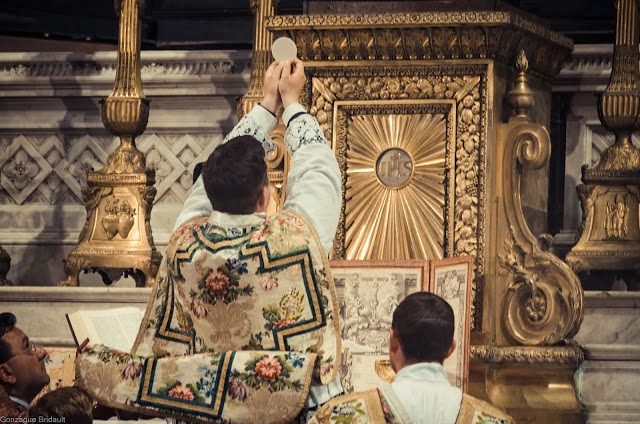
Eck insists that the Mass is the same sacrifice as the sacrifice on the cross because the priest and victim are the same, i.e., Jesus Christ. The Mass commemorates the sacrifice of the cross; it represents or makes present again Christ who was offered on the cross and it applies to men the merits won on the cross.
The following quotation from Cardinal Cajetan expresses in the clearest language the teaching of “all Churches since antiquity” on the sacrifice of the Mass, a teaching contradicted by the Reformers’ claim that every sacrifice must result in the death of the victim. “They assert, on the grounds that Christ is not offered in sacrifice unless he dies, that it is therefore false to say Christ is offered in the Eucharist…But understand that neither the death of Christ nor the state of his being dead is brought about here in reality. Christ is living and reigning in heaven, and consequently his death is not contained but is signified in this sacrifice. Understand also these two truths: in this sacrifice Christ is both signified and contained; but his death, while it is indeed signified, is not contained. Hence it does not follow that as often as this sacrifice is offered Christ must die; but it is certainly true that he is contained and offered in it.”
In protecting the sacrifice of the Mass against the attacks of the Reformers, these and other apologists were faithful to the teaching and practice of the Catholic Church from the beginning. That teaching rested on the substantial change of bread and wine into Christ’s body and blood which Christ the eternal high priest performs at every Mass through the ministry of His ordained priest. If men do not believe in this Real Presence, they cannot believe in the sacrifice of the Mass.

BOOKS
The Real Presence – Fr. Buckley FSSP
The Blessed Eucharist: Our Greatest Treasure – Fr. Michael Mueller
EXPLORE
Affirmation of Faith
St. Paschal Baylon, Seraph of The Eucharist
About
The Experiment
International Crusade of Eucharistic Reparation
The Eucharistic Fast & Law of Abstinence
Reception on the Tongue, Kneeling
Received and Not Owed
Behavior in Church
Communion Bread Making
Thoughts on the New Rite of Mass
Spiritual Communion
Quas Primas
Pange Lingua
Contact
Send Prayer Request
©2026 REALPRESENCE.INFO.
 THE REAL PRESENCE