
by
FATHER MICHAEL MÜLLER
Priest of the Congregation of the Most Holy Redeemer

“In the midst of you standeth One Whom you know not— the latchet of Whose
shoe I am not worthy to loose.” — John i. 26, 27.
ELEVENTH REVISED EDITION.
NEW YORK AND CINCINNATI;
FR. PUSTET,
Printer to the Holy Apostolic See and the S. Cong, of Rites.
1880
Copyright,
ERWIN STEINBACK, 1878
PROTEST OF THE AUTHOR
In obedience to the decrees of Urban VIII. of holy memory, I protest that I do not intend to attribute any other than purely human authority to all the miracles, revelations, graces and incidents contained in this book; neither to the titles holy or blessed applied to the servants of God not yet canonized, except in cases where these have been confirmed by the Holy Roman Catholic Church and by the Holy Apostolic See, of whom I profess myself an obedient son; and, therefore, to their judgment I submit myself and whatever I have written in this book.

PREFACE
My Dear Reader and Brother in Jesus Christ:
SINCE the spirit of devotion that has urged me to write this book, animates you to read it and makes us the happy children of the same loving Father, should you ever hear any person say I might have spared myself the labor, there being already so many learned and celebrated works which treat of this subject, I beg you to answer that our Lord Jesus Christ, in the Adorable Sacrament, is such an abundant fountain that the more it flows the fuller it becomes, and the fuller it is the more it flows, which signifies that the most Holy Eucharist is so great and so sublime a mystery that the more we say of it the more remains to be said. If St. Alphonsus could say with all truth of the Passion of our Lord, “that eternity will not suffice to meditate adequately upon it,” we may affirm the same of Jesus Christ hidden in the Blessed Sacrament, and with a thousand times more justice apply to our subject what St. Augustine says in praise of the Blessed Virgin, viz: that all the tongues of men, even if all their members were changed into tongues, would not be sufficient to praise her as she deserves.
“Worldly lovers are accustomed frequently to mention and praise those whom they love, that others also may praise and applaud them ; how poor and weak should we then consider the love of those who call themselves lovers of the Blessed Sacrament, and yet who seldom speak of it or think of endeavoring to inspire others with a love of it. The true lovers of the most Blessed Sacrament do not act thus; they speak of it, praise it everywhere, in public and in private; whenever it is in their power they try to enkindle in the hearts of all those ardent flames of love with which they themselves burn for their beloved Jesus.
The object of this little book is, then, to make Jesus, in the Blessed Eucharist, more generally known and better loved. Our Divine Saviour is ready to bestow innumerable graces through this Sacrament, which are lost in consequence of the ignorance and indifference of men. When the most Holy Sacrament of the Altar is not revered and loved, scandals will abound, faith will languish, and the Church mourn. On the other hand, if this Sacrament be worthily frequented, peace will reign in Christian hearts, the devil will lose power and souls will be sanctified. “As many as received Him to them He gave power to be made the sons of God.” It has seemed to me that a work explanatory of the prominent points of this mystery, written in a simple and familiar style, would greatly contribute to remove the obstacles to a right appreciation of this wonderful Sacrament of Divine love ; and with this conviction I have ventured to lay the following pages before the public, trusting, with the blessing of God, they may prove useful to many souls.
As Almighty God in His goodness imparts His favors to His faithful followers in divers ways, some times by enlightening their minds in a supernatural manner, and even conversing with them familiarly as it were, and as the nature of this work is intended to be practical, not controversial, I have thought it expedient for the edification of pious souls to introduce into it, after the manner of the Holy Fathers, both some revelations made to certain saints, and several miraculous facts concerning this mystery. I know there are some persons who, boasting of being free from prejudices, take great credit to themselves for believing in miracles but those recorded in the Holy Scriptures, esteeming all others as tales and fables for foolish women. But it will be well to remember here a remark of the learned St. Alphonsus, who says, “that the bad are as ready to deride miracles as the good are to believe them ; adding, that, as it is a weakness to give credit to all things, so, on the other hand, to reject miracles which come to us attested by grave and pious men, either savors of infidelity which supposes them impossible to God, or of presumption which refuses belief to such a class of authors. We give credit to a Tacitus, a Suetonius, and can we deny it without presumption to Christian authors of learning and probity. There is less risk in believing and receiving what is related with some probability by honest persons and not rejected by the learned, and which serves for the edification of our neighbor, than in rejecting it with a disdainful and presumptuous spirit.” Hence Pope Benedict XI V. says: “Though an assent of Catholic faith be not due to them, they deserve a human assent according to the rules of prudence by which they are probable and piously credible.”
Now should the Reverend Clergy deem this publication ever so little calculated to promote devotion to the Blessed Sacrament, the compiler will believe himself amply rewarded for his labor if they encourage its circulation.
Michael Müller, C.S.S.R.
St. Alphoxsus’, Baltimore, Md.
December 8th, 1867.

CHAPTER I.
The Doctrine of the Real Presence
CHAPTER II.
On the Reverence due to Jesus Christ in the Blessed Sacrament
CHAPTER III.
On the Love op Jesus Christ in the Blessed Sacrament
CHAPTER IV.
On Visiting Jesus Christ in the Blessed Sacrament
CHAPTER V.
On the Great Desire of Jesus Christ to enter into our Hearts in Holy Communion
CHAPTER VI.
On Preparation for Communion
CHAPTER VII.
On Thanksgiving after Communion
CHAPTER VIII.
On the Effects of Holy Communion
CHAPTER IX.
The Excuses of those who do not Communicate Frequently
CHAPTER X.
On Unworthy Communion
CHAPTER XI
On Spiritual Communion
CHAPTER XII.
Considerations on the Virtues that Jesus Christ Teaches us in the Most Holy Sacrament of the Altar
CHAPTER XIII.
The Most Holy Festival of Corpus Christi and its Origin
CHAPTER XIV.
Additional Examples Relating to the Real Presence
CHAPTER XV.
The Most Holy Sacrifice of the Mass
CHAPTER XVI.
On the Ceremonies of Mass
CHAPTER XVII.
An Exhortation to hear Mass Devoutly
CHAPTER XVIII.
Examples Relating to the Holy Sacrifice of the Mass
FATHER MICHAEL MÜLLER, CSSR (1825 – 1899)
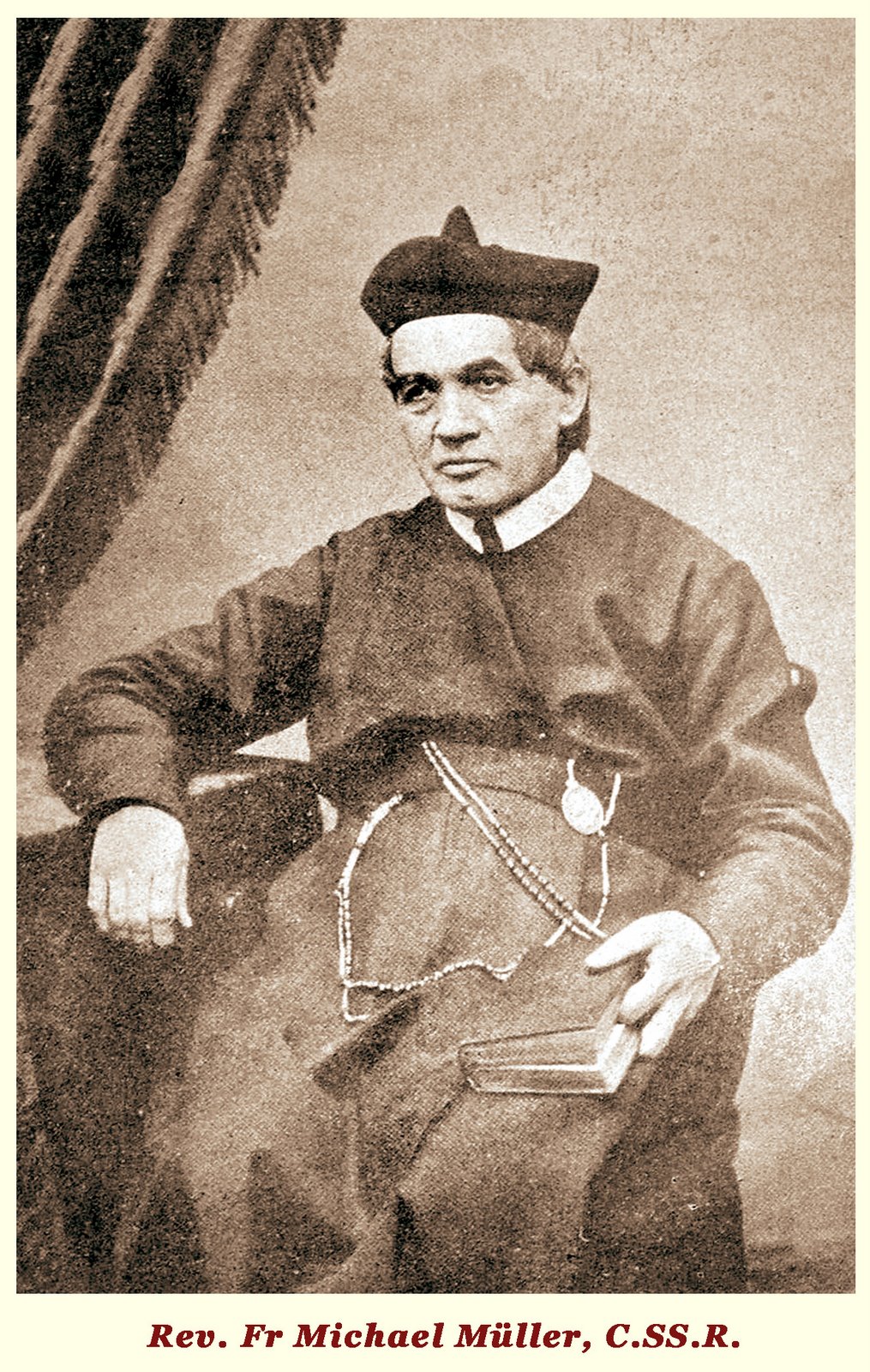
Father Michael Müller, who so highly deserves credit for the rebuilding of the Annapolis church and monastery (Maryland, United States of America,) saw the light of this world in the humble village of Brück in the Diocese of Trier, Germany on 18 December, 1848. His early education was that of country-boys. On leaving school, he sighed after the priesthood.
His holy desire was furthered by his admission to the Gymnasium of Trier. In spite of all difficulties, he obeyed the voice of God calling him to the Congregation of the Most Holy Redeemer. At St Trond, in Belgium, he made his novitiate and pronounced his vows in 1848, and then continued his studies at Wittem. There he imbibed that spirit of prayer which the saintly Father Passerat had left as a holy heritage.
In 1850, Father Bernard Hafkenschied, the American Provincial, had visited Europe and augmented his small number of apostolic labourers in America by the addition of several young Fathers and clerical students from the Old World. Among the latter was Br Michael Müller. He and his companions finished their studies in America, at Cumberland and Rochester, and were ordained by St John Neumann, then Bishop of Philadelphia, on 26 March, 1853.
Shortly after his ordination Father Müller was sent to New Orleans. He did not stay long there, as the southern climate proved unfavourable to his constitution. In May, 1854 therefore, he was transferred to Cumberland, where the important office of Spiritual Prefect of Students was entrusted to him.
This was an evident sign that his superiors placed great confidence in his solid piety and prudence. As Prefect he strived by word and example to inspire the young clerics with the spirit he had himself imbibed in Belgium. After three years, that is in 1857, he was made Master of Novices and Superior at Annapolis.
At the time of the separation of the Provinces he was affiliated to the Western, or St Louis Province, and became for one term also, from 1877 to 1880, Rector of St Michael’s, Chicago. Later on, from 1884 to 1887, he was called back East and filled for three years the rectorship of St Philomena’s, Pittsburg. Everywhere Father Müller displayed untiring zeal for the welfare of souls committed to his care, and for the maintenance of regular discipline.
One feature of his zeal for souls was his literary activity. Fr Müller published several books and one major work – God, the Teacher of Mankind – in nine volumes. Most of his writings were intended for the laity, but some were written for priests and especially for religious.
Books written by
Fr. Müller include:
The Golden Rule
Our Lady of Perpetual Help in the Work of our Redemption and Sanctification
The Prodigal Son; or, the Sinner’s return to God
Prayer, the Key of Salvation
Public School Education
The Blessed Eucharist. Our Greatest Treasure
Triumph of the Blessed Sacrament, or History of Nicola Aubry
The Religious State
Devotion to the Holy Rosary
The Purgatorian Consoler
Of his nine-volume work – God, The Teacher of Mankind; or, Popular Catholic Theology, Apologetical, Dogmatical, Moral, Liturgical, Pastoral and Ascetical – the volumes are as follows:
Volume I. The Church and Her Enemies.
Volume II. The Apostles Creed.
Volume III. The First and Greatest Commandment.
Volume IV. Explanation of the Commandments continued.
Volume V. Dignity, Authority and Duties of Parents, Ecclesiastical and Civil Powers. Their Enemy.
Volume VI. Grace and the Sacraments.
Volume VII. The Holy Mass: The sacrifice for the living and the dead, the clean oblation offered up among the nations from the rising to the setting of the sun.
Volume VIII. Holy Eucharist and Penance.
Volume IX. Sacramentals, Prayer, Vices and Virtues, Christian Perfection, etc.
The Catholic Dogma: Extra Ecclesiam Nullus Omnino Salvatur.
Father Müller also published four Catechisms: For Beginners, For Parochial and Sunday Schools, For Academies and High Schools, and For the Family and Students.
He continued his arduous labours almost to the time of his death. It was only in the latter years of his life that his health began absolutely to fail, although he could never be counted among the robust. It was permitted to him to end his days at Annapolis, where he had erected an everlasting monument to his zeal and piety, and where also he had the consolation of a grand celebration of the fiftieth anniversary of his religious profession. He died in Annapolis on 28th August, 1899. †
Source: Papa Stronsay Texts

BOOKS
The Real Presence – Fr. Buckley FSSP
The Blessed Eucharist: Our Greatest Treasure – Fr. Michael Mueller
EXPLORE
Affirmation of Faith
St. Paschal Baylon, Seraph of The Eucharist
About
The Experiment
International Crusade of Eucharistic Reparation
The Eucharistic Fast & Law of Abstinence
Reception on the Tongue, Kneeling
Received and Not Owed
Behavior in Church
Communion Bread Making
Thoughts on the New Rite of Mass
Spiritual Communion
Quas Primas
Pange Lingua
Contact
Send Prayer Request
©2026 REALPRESENCE.INFO.
 THE REAL PRESENCE