

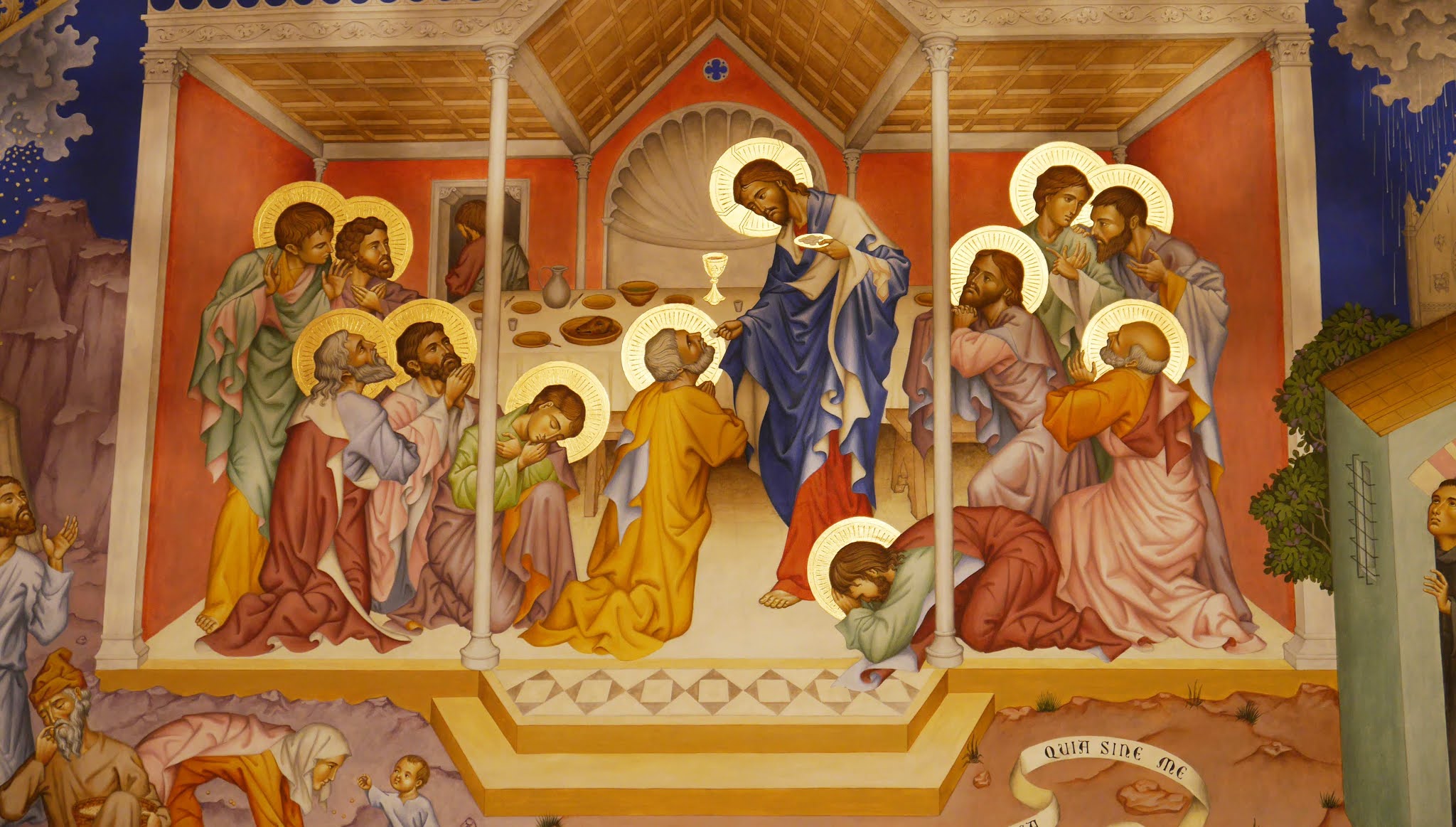

“A spiritual communion is an earnest desire to receive Communion in reality, by which desire we make all preparations and thanksgivings that we would make…” [if we were about to receive Jesus sacramentally—Body, Blood, Soul, and Divinity]. “…Spiritual Communion is an act of devotion that must be pleasing to God and bring us blessings from Him.” (Baltimore Catechism, 912)
If a person is unable to participate in the most perfect way, which is participation at Holy Mass; we can thank God for the good, but less perfect manner of spiritual communion1
Thomas unequivocally teaches in Summa Theologica, Part Three, Q. 80, A. 1, Sed Contra: “We hold that there are two ways of eating, the one sacramental and the other spiritual.”
Moreover, he explained that Consecration of the proper matter makes the Eucharist a sacrament, whereas in Baptism and Confirmation, it is in the receiving of the sacraments. The priest, not the communicant, makes Christ present in the Holy Eucharist.
Thomas reminded us of the truth that Jesus Christ is present, body, blood, soul, and divinity in the Blessed Sacrament, whether we receive communion corporeally or not. Grace exudes from our Chapel’s tabernacle, where our King resides, as it emanates from your tabernacles in your parish churches. He dwells, gloriously alive in His Risen Body! (CCC, 1374) (ST, Part III, Q. 75, A. 1)
In addition, Thomas compared spiritual communions to the Baptism of Desire. He writes in ad 3 : “ … just as some are baptized with the Baptism of desire, before being baptized in the baptism of water, so likewise some eat this sacrament (the Eucharist) spiritually prior to receiving it sacramentally.”
In other words, just as we believe in the efficacy of the Baptism of Desire, so we can trust in the real effects from the “Eucharist of Desire.”
Aquinas teaches in ad 3 that the receiving of this sacrament can be seen in two ways:
1) “First of all, from the desire of receiving the Sacrament itself.” He writes that they “can eat this sacrament spiritually, not sacramentally if they have desired to receive this sacrament since its institution.”
2) “Secondly, by a figure: thus the Apostle says (1 Cor 10:2) that the fathers of old were baptized in the cloud and in the sea, and that they did eat … spiritual food, and …drank … spiritual drink.”
In thinking about this article, it’s important to note that Thomas did write, “sacramental eating is not without avail, because the actual receiving of the sacrament produces more fully the effect of the sacrament than does the desire thereof …”
He then refers to Q. 69, A. 4, ad 2:
“… a man receives the forgiveness of sins before Baptism insofar as he has Baptism of desire … and yet when he actually receives Baptism, he receives a yet greater fullness of grace and virtues.”
This is an important point. Once we again can attend Mass and receive sacramental Communion, a faulty understanding — “I can just receive a spiritual communion” — may hinder some from receiving the sacraments. The Church unequivocally teaches that the sacraments are necessary for salvation.
St. Thomas states in the Summa, Part 3, Q. 61, Sed Contra: “Sacraments are necessary for salvation.”
Official Magisterium teaching reflects Thomas’ teaching; The Catechism of the Catholic Church, n. 1129, repeats the Council of Trent: The Church affirms that for believers the sacraments of the New Covenant are necessary for salvation.
My Jesus, I believe that You are in the Blessed Sacrament. I love You above all things, and I long for You in my soul. Since I cannot now receive You sacramentally, come at least spiritually into my heart. As though You have already come, I embrace You and unite myself entirely to You; never permit me to be separated from You.
[This] spiritual communion [prayer] begins with an explicit act of Faith, “My Jesus, I believe you are present in the Blessed Sacrament.” The Church teaches the sacraments are sacraments of faith” (CCC, 1123).
By this intention, we are not only “accepting the Lord into our hearts,” but we are inviting Jesus Christ, physically present in the Blessed Sacrament, to come spiritually into our hearts.
The Bellarmine Forum referring to the Catechism, writes:
“Spiritual communion consists in awakening within the heart a lively desire to receive holy communion.
To make a spiritual communion is a matter of no difficulty; it is enough to recollect one’s self for a few minutes, to place one’s self in spirit before the tabernacle, and to say: “Lord Jesus, come, I beseech Thee, into my heart.”
We ought to make a spiritual communion during Mass, more particularly at the communion of the priest, and also when we pay a visit to the Blessed Sacrament.
We may even communicate spiritually every hour of the day, the oftener the better. For this there is no need to fast beforehand, nor to obtain permission from our confessor.
Spiritual communion is the means of enriching the soul with many and precious graces.
Actual communion is compared to a golden, spiritual communion to a silver vessel. Our Lord, when on earth, did not heal those only to whom He went in person, but those also who were absent, and who ardently desired His presence. Remember how He acted in regard to the centurion’s servant; He does the same now as He did then (Cochem). The Council of Trent says (13, 8): “Those who eat in desire that heavenly bread, are by a lively faith which worketh by charity, made sensible of the fruit and usefulness thereof.” Spiritual communion is the best preparation for sacramental communion. Our Lord did not come to earth until His advent was ardently desired; and in like manner He is reluctant to visit the soul that does not earnestly long to receive Him.”
In order to make a spiritual communion, we can humbly offer one of the traditional prayers (see below for a selection), or speak interiorly with love using our own words, and afterwards, just as we do when receiving Holy Communion at Mass, we must spend time with Our Blessed Lord in thanksgiving.
St. Leonard of Port-Maurice offered this guidance for making a spiritual communion:
“In order to facilitate a practice of such great excellence, ponder what I have to say. When the priest is about to give himself Communion in holy Mass, do you, keeping composed externally and internally, excite in your heart an act of true contrition, and humbly striking your breast, in token that you acknowledge yourself unworthy of so great a grace, make all those acts of love, of self-surrender, of humility, and the rest, which you are accustomed to make when you communicate sacramentally, and then desire with a lively longing to receive your good Jesus…And to kindle your devotion, imagine that most holy Mary, or some saint, your holy advocate, is holding forth to you the sacred [Host]; [imagine] yourself receiving it, and then, embracing Jesus in your heart, reply to Him, over and over again, with interior words prompted by love: “Come, Jesus, my Beloved, come within this my poor heart; come and satiate my desires; come and sanctify my soul; come, most sweet Jesus, come!” This said, be still; contemplate your good God within you, and, as if you really had communicated, adore Him, thank Him, and perform all those interior acts to which you are accustomed after sacramental Communion.”
PRAYERS OF SPIRITUAL COMMUNION
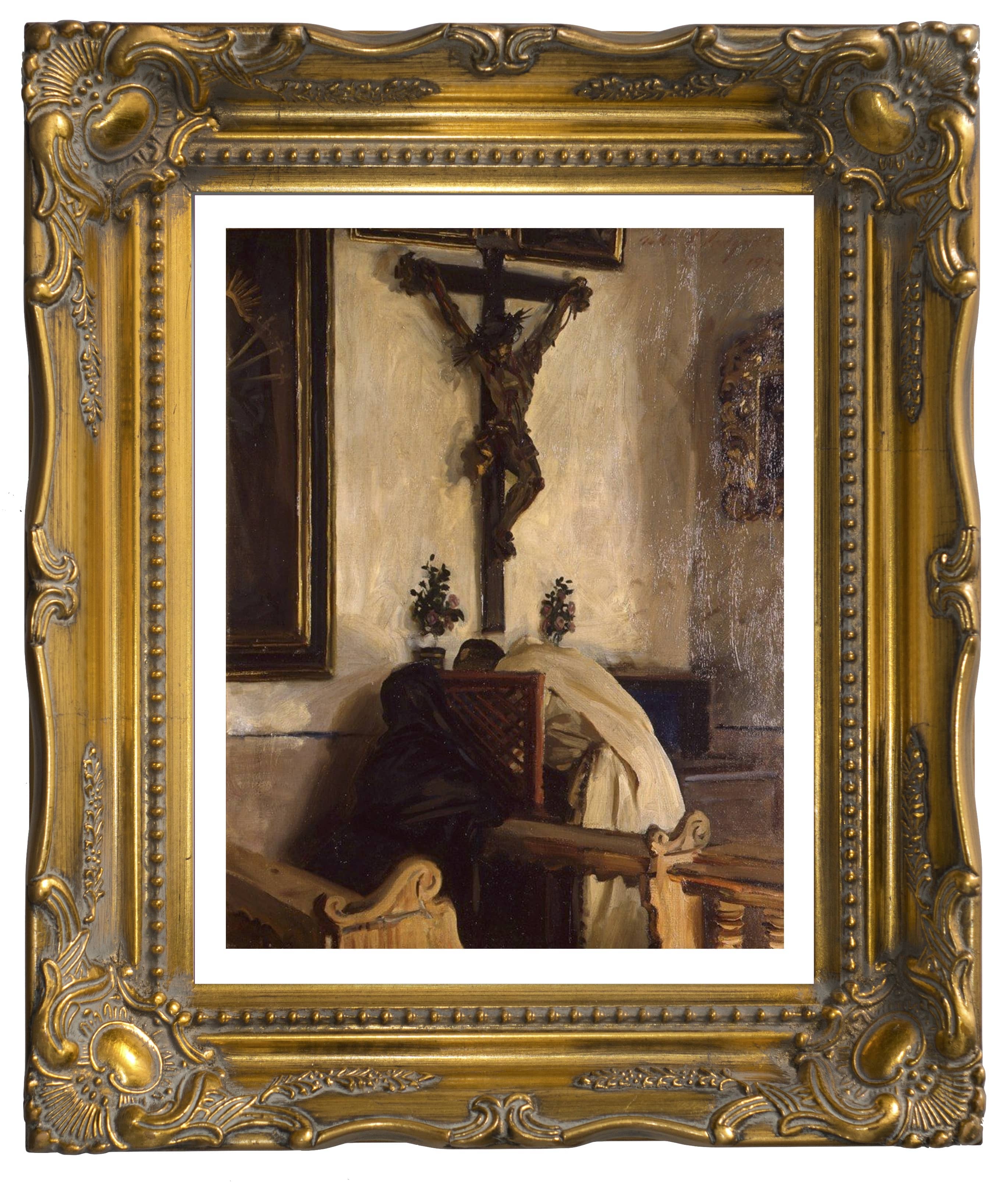
Since O my Saviour, I cannot actually receive Thee as the food of my soul in the Blessed Sacrament, I will at least communicate spiritually and thus gain some measure of profit. Prostrate before Thee in spirit, I declare my firm and steadfast belief that Thou are really and actually here present in the Most Holy Sacrament, under the form of bread present in Thy flesh and blood, Thy body and soul, Thy divinity and humanity, living, Thou, the Eternal Truth, hast commanded us to believe it. Would that I could now receive this Sacrament of Thy love. I long for the blissful moment when I shall be permitted to receive Thee. But now at least let me approach in spirit to kiss the sacred wounds Thou didst receive for my sake; in spirit hide myself in Thy pierced side, Thy divine heart, that I may live not only for what Thou hast done for me, but may live with Thee and for Thee, as Thy child, Thy brother, as a member of that mystical body of which Thou art the head. Thy infinite goodness and power, Thy gracious invitation, Thy unfailing promise, encourage me to hope that Thou wilt not despise me, but wilt receive me in mercy, and enrich me with Thy grace and Thy love. (Father Martin Von Cochem, circa 1700)
O Jesus I turn toward the holy tabernacle where You live hidden for love of me. I love you, O my God. I cannot receive you in Holy Communion. Come nevertheless and visit me with Your grace. Come spiritually into my heart. Purify it. Sanctify it. Render it like unto Your own. Amen.
Lord, I am not worthy that thou shouldst enter under my roof, but only say the word and my soul shall be healed.” (The Raccolta 1944)
At Thy feet, O my Jesus, I prostrate myself and I offer Thee repentance of my contrite heart, which is humbled in its nothingness and in Thy holy presence. I adore Thee in the Sacrament of Thy love, the ineffable Eucharist. I desire to receive Thee into the poor dwelling that my heart offers Thee. While waiting for the happiness of sacramental communion, I wish to possess Thee in spirit. Come to me, O my Jesus, since I, for my part, am coming to Thee! May Thy love embrace my whole being in life and in death. I believe in Thee, I hope in Thee, I love Thee. Amen. (Servant of God Rafael Merry del Val)
I wish, my Lord, to receive you with the purity, humility, and devotion with which your most holy Mother received you, with the spirit and fervor of the saints. Amen. (St. Josemaría Escrivá)
O Immaculate Queen of Heaven and Earth, Mother of God and Mediatrix of every grace: I believe that Thy dearly beloved Son, Our Lord Jesus Christ, is truly, really, and substantially contained in the Most Blessed Sacrament. I love Him above all things and I long to receive Him into my heart. Since I cannot now receive Him sacramentally, be so good as to place Him spiritually in my soul. O my Jesus, I embrace Thee as One who has already come, and I unite myself entirely to Thee.
Never permit me to be separated from Thee. Amen.
As I cannot this day enjoy the happiness of assisting at the holy Mysteries, O my God! I transport myself in spirit at the foot of Thine altar; I unite with the Church, which by the hands of the priest, offers Thee Thine adorable Son in the Holy Sacrifice; I offer myself with Him, by Him, and in His Name. I adore, I praise, and thank Thee, imploring Thy mercy, invoking Thine assistance, and presenting Thee the homage I owe Thee as my Creator, the love due to Thee as my Savior.
Apply to my soul, I beseech Thee, O merciful Jesus, Thine infinite merits; apply them also to those for whom I particularly wish to pray. I desire to communicate spiritually, that Thy Blood may purify, Thy Flesh strengthen, and Thy Spirit sanctify me. May I never forget that Thou, my divine Redeemer, hast died for me; may I die to all that is not Thee, that hereafter I may live eternally with Thee. Amen.
1. Source: Faith In Action. “Alumna Sister: St. Thomas & Spiritual Communion” thomasaquinas.edu
https://www.thomasaquinas.edu/alumni/faith-action-blog/alumna-sister-st-thomas-spiritual-communion
BOOKS
The Real Presence – Fr. Buckley FSSP
The Blessed Eucharist: Our Greatest Treasure – Fr. Michael Mueller
EXPLORE
Affirmation of Faith
St. Paschal Baylon, Seraph of The Eucharist
About
The Experiment
International Crusade of Eucharistic Reparation
The Eucharistic Fast & Law of Abstinence
Reception on the Tongue, Kneeling
Received and Not Owed
Behavior in Church
Communion Bread Making
Thoughts on the New Rite of Mass
Spiritual Communion
Quas Primas
Pange Lingua
Contact
Send Prayer Request
©2026 REALPRESENCE.INFO.
 THE REAL PRESENCE