

CHAPTER I
“The Catholic Church believes…”
CHAPTER II
“From the testimony of the Fathers…”
CHAPTER III
“Not only the witness…”
CHAPTER IV
“The denial of the change…”
CHAPTER V
“In the august mystery…”
CHAPTER VI
“The devotional prayers…”
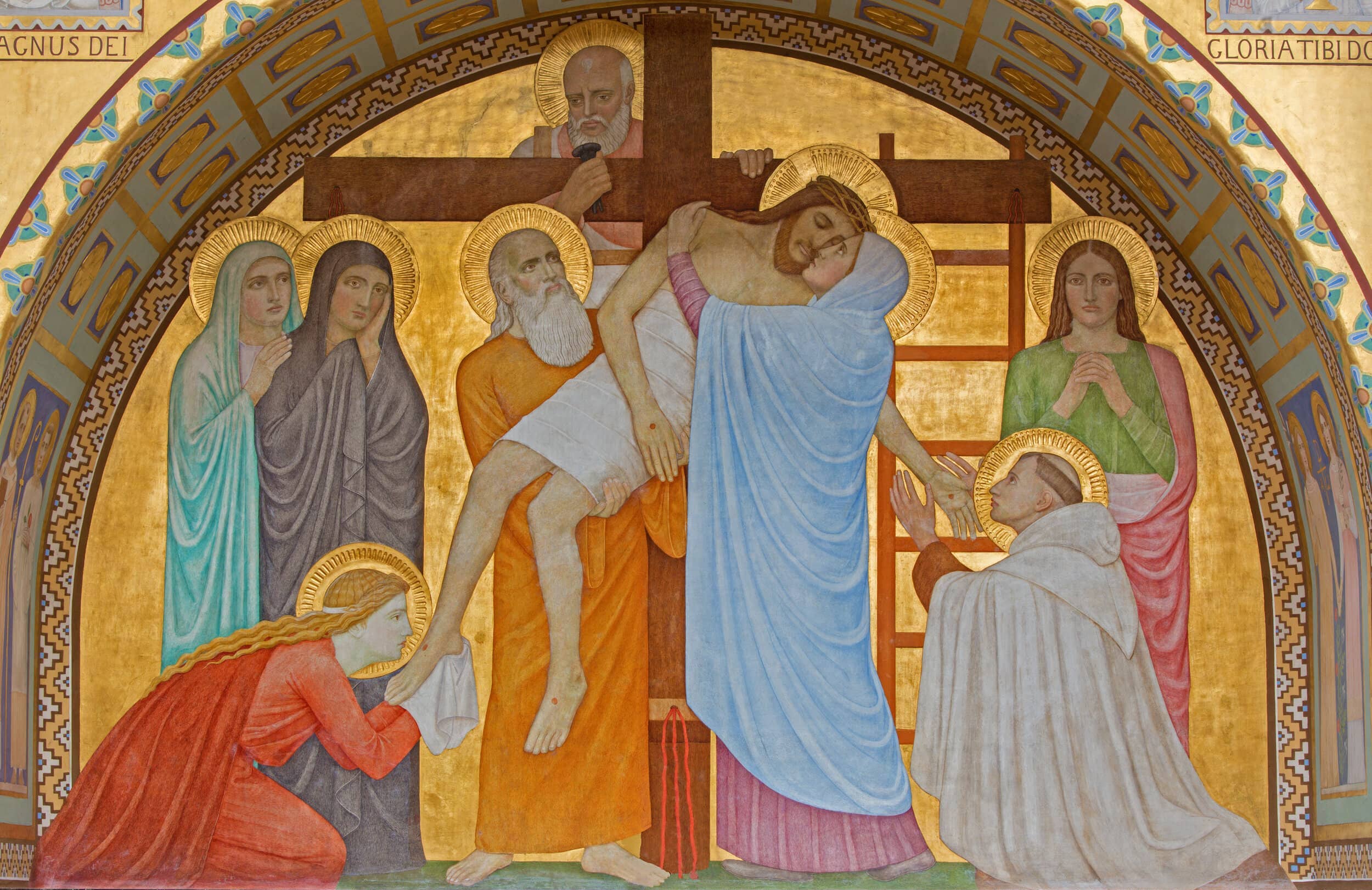
CHAPTER V
IN the august mystery of the Holy Eucharist the substance of bread and wine are changed into the body and blood of Christ, but the appearances of bread and wine remain. Our sense of sight, taste and touch are useless because the Eucharist looks like, tastes like and feels like bread and wine. Saint Thomas Aquinas, however, says that our sense of hearing can be trusted because we hear the voice of the Son of God who cannot deceive us. He says, “This is My Body…this is My Blood.” Unless Christ Himself had said it, who could possibly believe it to be true.
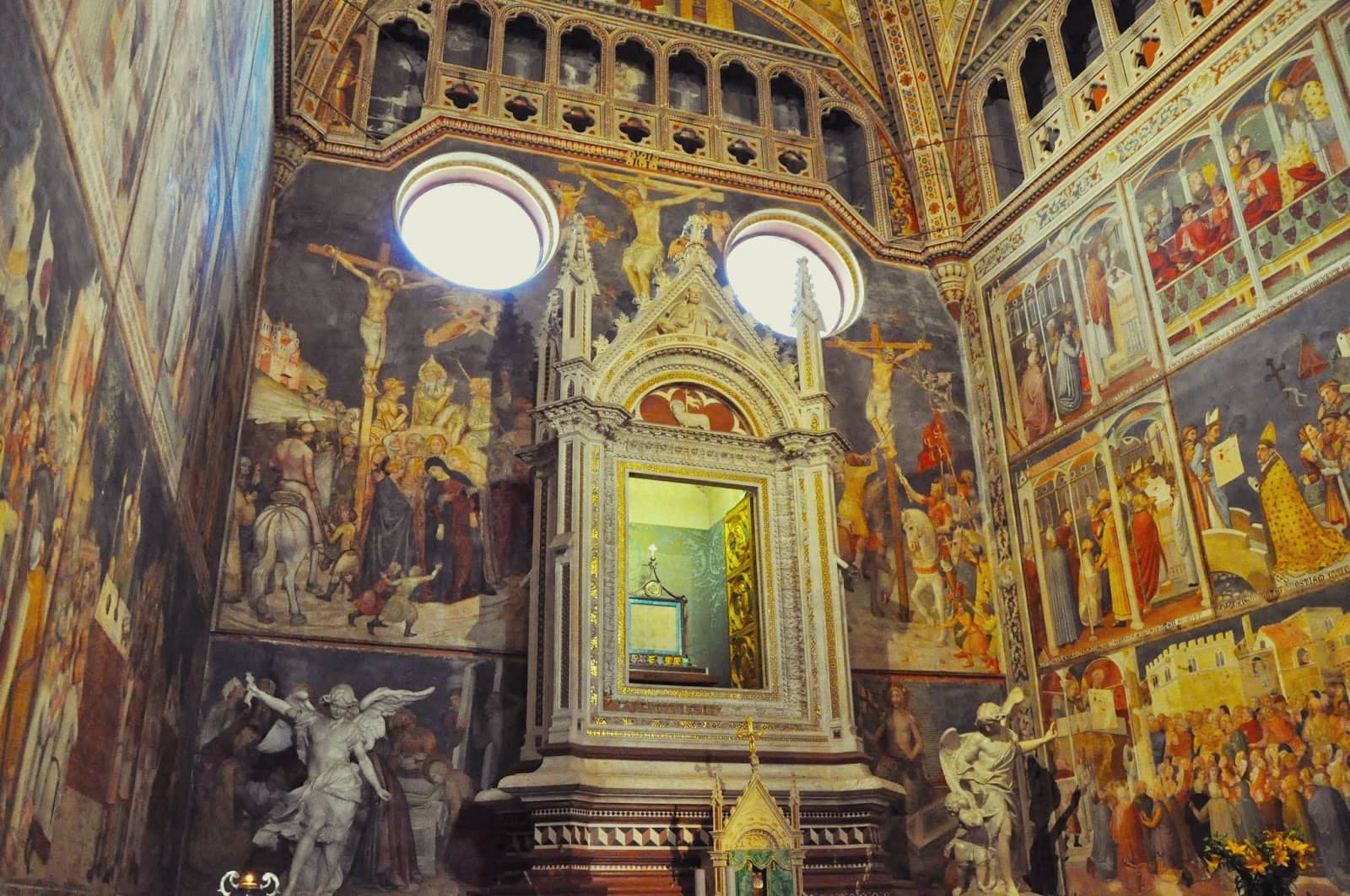
Although God is in no way obligated to do so, over the course of the ages He has worked miracles which confirm Christ’s Real Presence in the Eucharist. In 1263 in the diocese of Orvieto, Italy for example, a certain priest after pronouncing the words of consecration doubted their effect. There immediately flowed living blood from the host onto the corporal. That corporal lies stored in the cathedral of Orvieto and the miracle occasioned Pope Urban IV to establish the Feast of Corpus Christi for the universal Church.
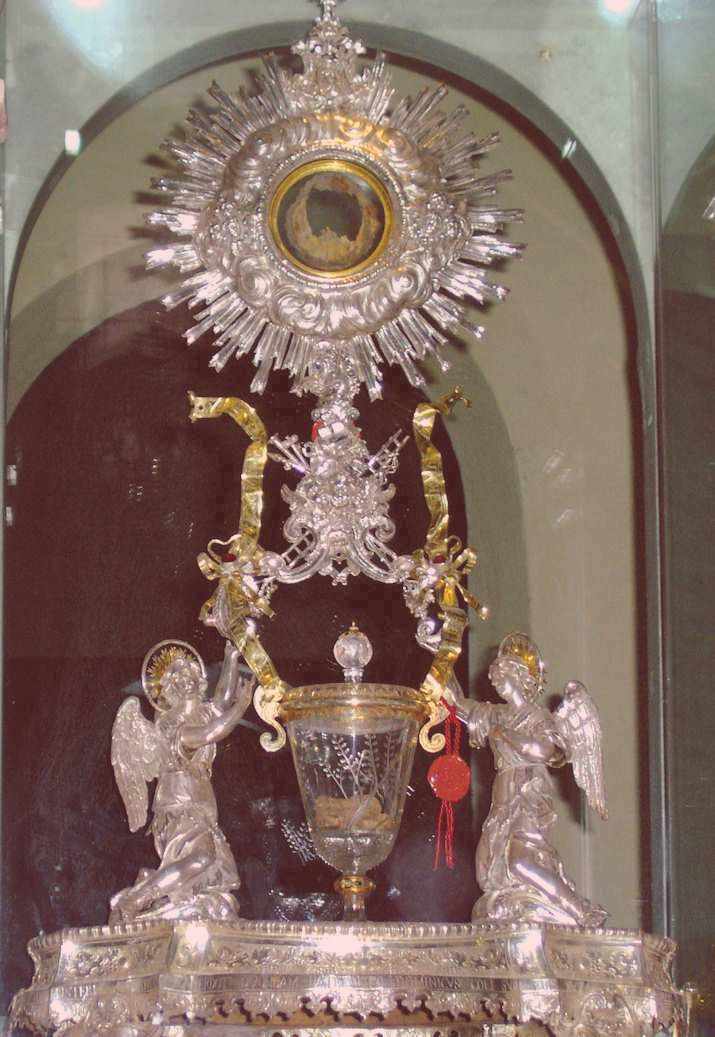
There is only one other miracle I will relate. It happened centuries before the one at Orvieto but its effect has astounded our own times. Around the year of our Lord 700 at the monastery of Saint Longinus near the town of Lanciano, Italy, a priest monk of the Order of Saint Basil, who had suffered recurring doubt about transubstantiation, was one day celebrating Mass. When he spoke the words of consecration, the Host was suddenly changed into a circle of flesh and the wine into visible blood. After gaining his composure and while weeping joyously, he spoke to the congregation: “O fortunate witnesses, to whom the Blessed God, to confound my unbelief, has wished to reveal Himself visible to our eyes! Come, brethren, and marvel at our God so close to us. Behold the flesh and blood of our Most Beloved Christ.”
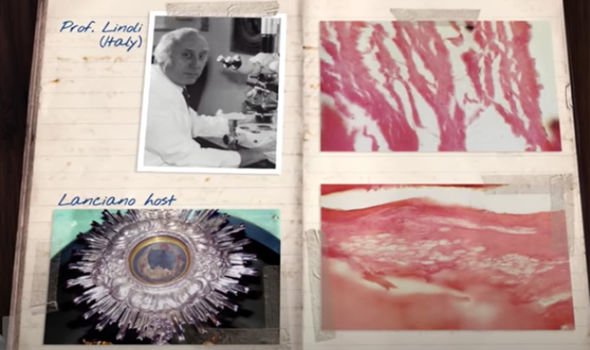
The flesh and blood, which had divided into five pellets, were placed in a reliquary of artistic ivory. On November 18, 1970—more than 1,250 years after they first appeared—these relics were subjected to a complete scientific examination by Professor Odoardo Linoli, university professor at large in anatomy and pathological histology, and in chemistry and clinical microscopy, head physician of the united hospitals of Arezzo.
In her book, Eucharistic Miracles, Joan Carroll Cruz presents the conclusions reached by Professor Linoli. She writes, “As a result of the microscopic studies, the following facts were ascertained and documented: The flesh was identified as striated muscular tissue of the myocardium (heart wall), having no trace whatsoever of any materials or agents used for the preservation of flesh. Both the flesh and the sample of blood were found to be of human origin. emphatically excluding the possibility that it was from an animal species. The blood and the flesh were found to belong to the same blood type: AB. The blood of the Eucharistic miracle was found to contain the following minerals: chlorides, phosphorus, magnesium, potassium, sodium in a lesser degree, and a greater quantity of calcium. Proteins in the clotted blood were found to be normally fractionated, with the same percentage ration as those found in normal fresh blood.
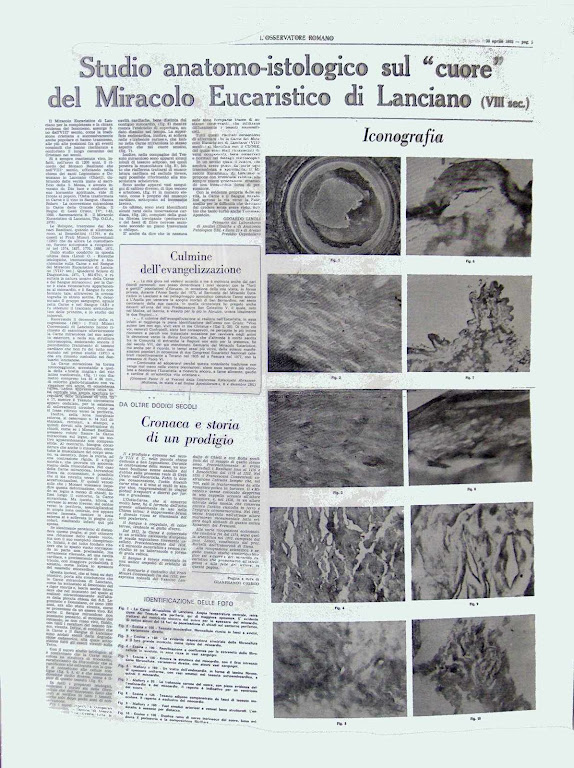
“Professor Linoli further noted the blood, had it been taken from a cadaver, would have altered rapidly through spoilage and decay. His findings conclusively exclude the possibility of a fraud perpetrated centuries ago. In fact, he maintained that only a hand experienced in anatomic dissection could have obtained from a hollow internal organ, the heart, such an expert cut, made tangentially—that is, a round cut, thick on the outer edges and lessening gradually and uniformly into nothingness in the central area. The doctor ended his report by stating that while the flesh and blood were conserved in receptacles not hermetically sealed, they were not damaged, although they had been exposed to the influences of physical, atmospheric and biological agents.”
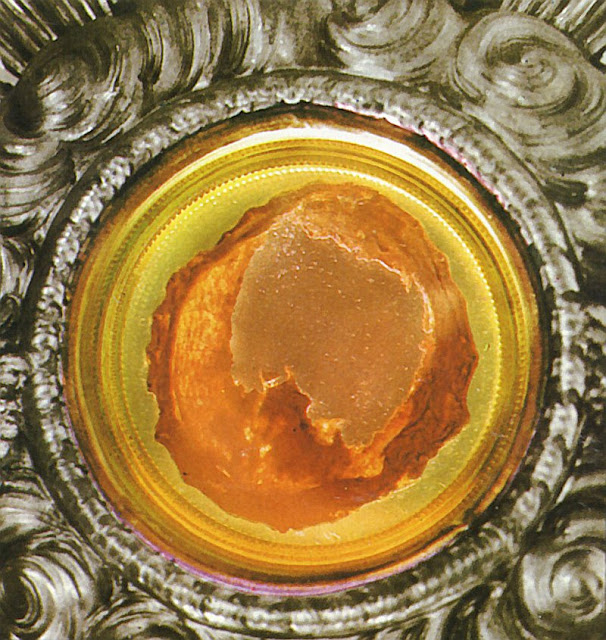
The examination of 1970 provides scientific proof that the contents in the reliquary of Lanciano are human flesh and blood. There is, moreover, historic evidence that the human flesh and blood in the reliquary have existed since approximately A. D. 700, and that they were placed in the reliquary because of their sudden appearance on the altar after the consecration of a Mass.
A miracle is something perceptible to the senses but beyond any created cause. Christ’s feeding 5,000 with a few loaves and a few fish, His changing water into wine instantaneously, healing the centurion’s servant at a distance and raising the dead were acts perceptible to the senses. Their cause, the mind of man realizes, was divine power. So too at Lanciano. It was not any created power that instantly changed the appearances of flesh and blood but the power of God confirming the Mystery of Faith.

BOOKS
The Real Presence – Fr. Buckley FSSP
The Blessed Eucharist: Our Greatest Treasure – Fr. Michael Mueller
EXPLORE
Affirmation of Faith
St. Paschal Baylon, Seraph of The Eucharist
About
The Experiment
International Crusade of Eucharistic Reparation
The Eucharistic Fast & Law of Abstinence
Reception on the Tongue, Kneeling
Received and Not Owed
Behavior in Church
Communion Bread Making
Thoughts on the New Rite of Mass
Spiritual Communion
Quas Primas
Pange Lingua
Contact
Send Prayer Request
©2026 REALPRESENCE.INFO.
 THE REAL PRESENCE